
Generative AI can draft text, summarise documents, write code, create images and answer questions about your own data. The challenge for most companies is not capability but choosing where to begin. This guide gives you a simple, low-risk path from first experiment to real business value.
What generative AI is good at
Generative AI is a pattern-based tool that produces new content from a prompt. It is strongest when the work involves language, structure and repetition:
- Summarising long documents, meetings and support tickets.
- Drafting emails, product descriptions, reports and social posts.
- Answering questions about your internal documents in plain language.
- Writing and explaining code, tests and documentation.
- Translating and adapting content for different audiences.
It is weaker at exact calculations, up-to-the-minute facts and anything that requires accountability. That is why a human check matters.
Start with a task, not a tool
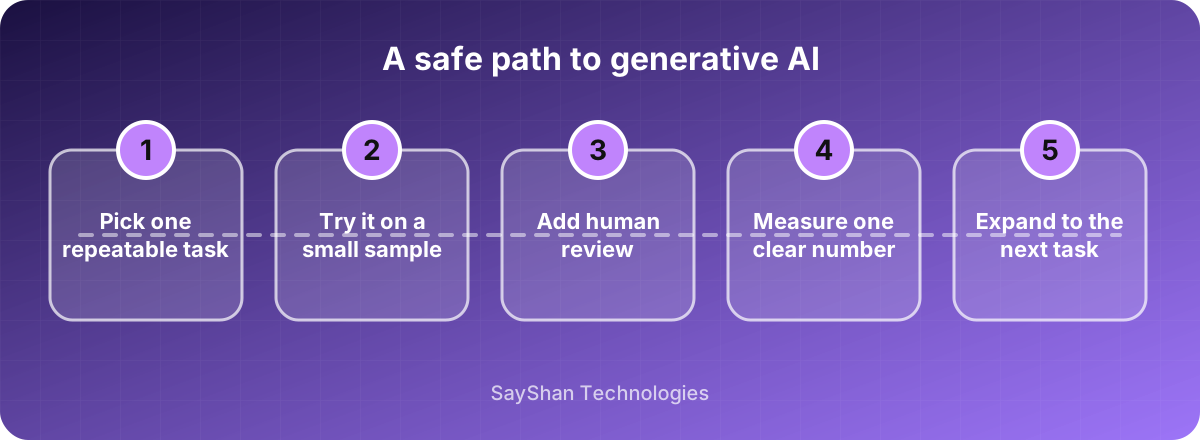
New tools appear every week, so choosing a tool first leads to endless comparison. Choose a task instead. Good first projects share three traits: they happen often, the result is easy to check and a mistake is cheap to fix.
Examples that fit well:
- Support teams: draft replies to common tickets for an agent to review.
- Sales and marketing: produce first drafts of proposals, product copy or newsletters.
- Operations: summarise long reports and turn meeting notes into action lists.
- Engineering: generate unit tests, explain legacy code and draft documentation.
Keep a person in the loop
Treat AI output as a draft. For anything customer-facing, a team member should review it until you have enough evidence that quality is consistently high. Over time you may let the AI act alone on the safest tasks, but earn that trust with data rather than assuming it.
Protect your data
Decide up front what information may be sent to an AI service:
- Classify data: public, internal, confidential and personal.
- Never paste passwords, customer personal data or trade secrets into tools you have not approved.
- Choose providers with clear terms on data retention and on whether your content is used for training.
- Write a one-page usage policy and share it with everyone.
Ground the AI in your own content
A general model does not know your prices, policies or product details. Techniques such as retrieval-augmented generation let the AI look up your approved documents before answering. This reduces made-up answers and keeps replies consistent with your brand and rules.
Measure the outcome
Pick one number before you begin, for example minutes saved per ticket, drafts approved without edits or time to produce a report. Compare against how long the task took before. If the number does not move, change the approach or stop. If it does, document what worked and move to the next task.
Common mistakes to avoid
- Starting too big. A company-wide transformation program is hard to measure and easy to abandon.
- Skipping training. People get far better results when they learn to write clear prompts and check output.
- Ignoring change management. Explain that the goal is to remove tedious work, not to replace people.
- Trusting output blindly. Always verify facts, numbers and quotes.
Key takeaways
- Choose one frequent, low-risk task and prove value there first.
- Keep humans reviewing output and protect confidential data.
- Ground the AI in your own approved content.
- Measure one number and expand only when it improves.
Keep learning
Frequently asked questions
Do we need our own AI model?
Usually not. Most businesses get excellent results by using existing models through an API and adding their own content and rules on top.
How much does it cost to get started?
A small pilot can be inexpensive because you pay mainly for usage. The larger cost is the time to prepare content, test quality and train your team.
Is generative AI accurate enough for business use?
It can be very good, but it can also be confidently wrong. That is why we recommend review steps, grounding in your documents and clear limits on what it may do.
Which department should start?
Pick the team with the most repetitive text-heavy work and an enthusiastic owner. Support, marketing and operations are common starting points.