Customers expect answers in minutes, not days. An AI chatbot can give them that without growing your support team, as long as it is designed as part of your support process rather than a replacement for it. This guide explains what a chatbot can realistically do, how to plan it and how to keep improving it after launch.
Why businesses add a chatbot
Most support inboxes are dominated by a small number of repeated questions: where is my order, how much does it cost, how do I reset my password, what are your opening hours. Each one is simple, but together they take a large share of your team's day. A chatbot handles those instantly, at any hour, and leaves people free for the conversations that need judgement and empathy.
The benefits are practical:
- Faster first response. Customers get an answer in seconds instead of waiting for the next working day.
- Consistent answers. The bot gives the same correct policy every time, rather than depending on who is on shift.
- Better use of your team. Agents spend time on complex cases, upsells and relationship building.
- Useful data. Every conversation shows what customers are confused about, which helps you fix your website, product or documentation.
How a modern chatbot works
Older chatbots followed rigid decision trees: press 1 for billing, press 2 for sales. Modern AI chatbots understand natural language. They read the customer's message, work out the intent and look up the answer in the content you give them, such as help articles, product catalogues and policy documents. Then they write a reply in a friendly tone.
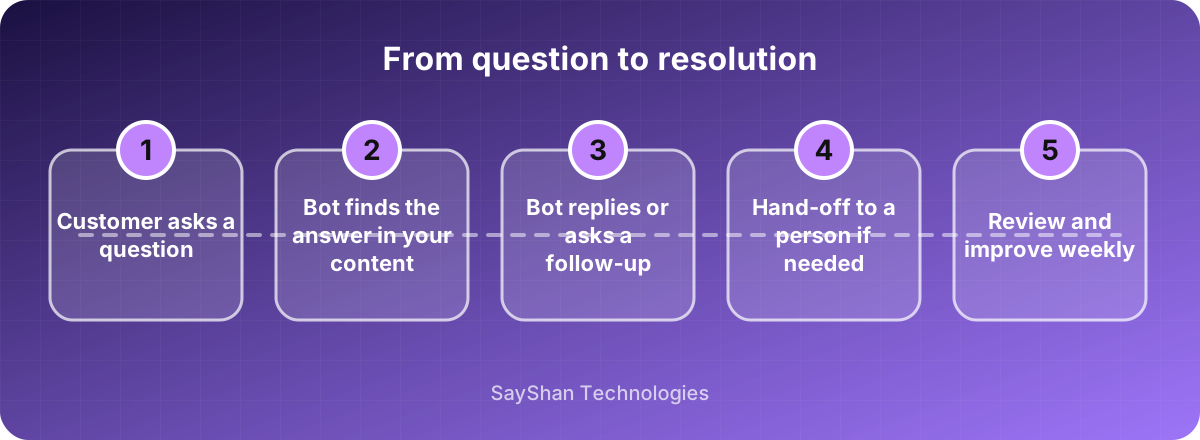
The important design idea is grounding: the bot should answer from your approved content, not from general knowledge. When it cannot find an answer, it should say so and offer a person, instead of inventing something that sounds plausible.
Decide what the bot should handle
Start narrow. Open your inbox and chat history for the last two or three months and group the messages by topic. Pick the twenty most common questions and write down the correct answer for each. That list becomes the first version of your bot's knowledge.
Good candidates for automation:
- Order status, delivery times and returns.
- Pricing, plans and feature comparisons.
- Account help such as password resets and invoices.
- Booking, rescheduling and availability.
- Basic product recommendations.
Keep people in charge of complaints, sensitive situations, refunds above a threshold, legal questions and anything where a wrong answer would be costly.
Design the hand-off to a human
The hand-off decides whether customers love or hate your chatbot. Three rules help:
- Make it easy to reach a person. A visible "talk to a human" option builds trust and reduces frustration.
- Pass the whole conversation along. The agent should see what was already said, so the customer never has to repeat themselves.
- Hand off automatically when needed. If the bot is unsure twice in a row, or the customer sounds upset, escalate.
Set clear limits
Write down what the bot must not do. For example: it never promises refunds, never gives medical, legal or financial advice, never shares another customer's information and never makes up delivery dates. Test these limits with tricky questions before you go live.
Choose where to deploy
Think about where your customers already talk to you. A chat widget on your website is the usual start. Many businesses also connect WhatsApp, Facebook Messenger or Telegram, because customers prefer the apps they use every day. Build the knowledge base once and reuse it across channels, so answers stay consistent.
Measure and improve
Review the numbers and read real conversations every week:
- Resolution rate: the share of chats solved without a human.
- Hand-off rate and reasons: what is the bot unable to answer?
- Customer satisfaction: a simple thumbs up or down after the chat.
- Unanswered questions: each one is a gap in your content.
A chatbot is never finished. Treat it like a new team member: train it, review its work and give it more responsibility as it earns trust.
Key takeaways
- Start with the twenty most common questions, not with the technology.
- Ground the bot in your own approved content and let it say "I don't know".
- Design the human hand-off first; it protects the customer experience.
- Review conversations weekly and keep improving the content.
Keep learning
Frequently asked questions
Will a chatbot replace my support team?
No. It takes over repetitive questions so your team can focus on complex and sensitive cases. Most businesses see their agents become more specialised, not redundant.
How long does it take to launch a first version?
A focused first version covering your most common questions can often be live within a few weeks. The time depends mainly on how ready your content is.
Can the chatbot work in several languages?
Yes. Modern language models understand many languages, but you should test each language with native speakers and keep your source content accurate in every language you support.
Is customer data safe?
It can be, if you choose providers with clear data-handling terms, avoid sending unnecessary personal data and restrict what the bot can access. Document these rules before launch.