
When you plan a mobile app, one of the first decisions is how to build it. Both native and cross-platform approaches are valid, and both power successful products. The right choice depends on your goals, budget and the experience you want to deliver.
The two approaches in plain language
Native development means building separate apps for each platform with the platform's own tools: Swift (or Objective-C) for iOS and Kotlin (or Java) for Android. Each app is written specifically for its operating system.
Cross-platform development means writing most of the app once and running it on both iOS and Android. The most popular frameworks today are Flutter (Dart) and React Native (JavaScript or TypeScript).
Native: strengths and trade-offs
Strengths
- Best access to the newest device features such as advanced camera, sensors and system widgets.
- The smoothest performance for graphics-heavy and animation-heavy apps.
- A user experience that feels at home on each platform.
Trade-offs
- Two codebases, two skill sets and usually two teams.
- Higher cost and a longer timeline, because features are built twice.
- More effort to keep both apps consistent.
Cross-platform: strengths and trade-offs
Strengths
- One codebase for iOS and Android, which speeds delivery and cuts cost.
- Easier maintenance: a fix or feature is written once.
- Good performance, more than enough for most business apps.
- A consistent look and behaviour on both platforms.
Trade-offs
- Some advanced hardware features still need native code.
- You depend on the framework's roadmap and updates.
- A very platform-specific design can take extra effort to achieve.
Flutter or React Native?
Both are mature and widely used.
- Flutter draws its own interface, which gives pixel-perfect consistency and excellent animation. It is a strong choice when design control matters.
- React Native uses real native components and lets web teams reuse JavaScript and React skills. It is a strong choice when you already have a React team or share logic with a web app.
How to decide
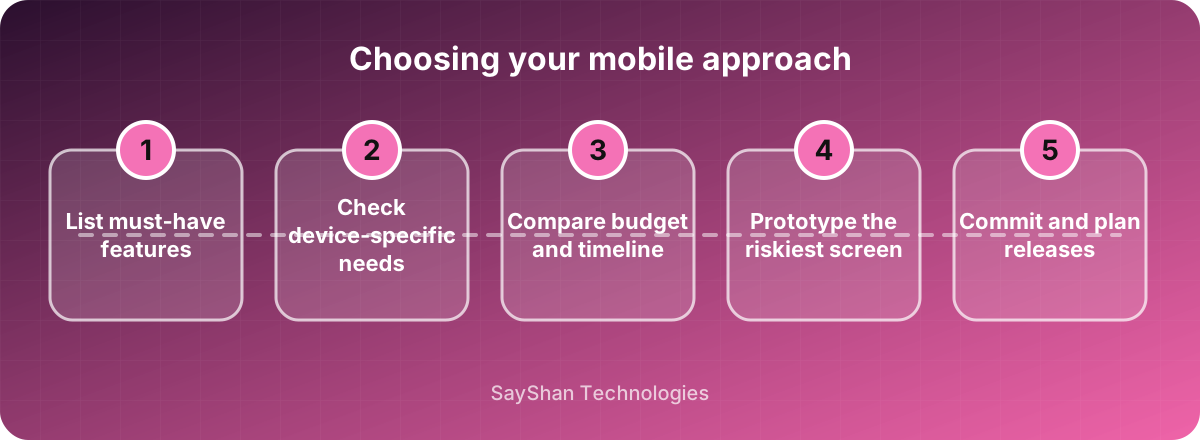
- Budget or time is tight? Choose cross-platform.
- Heavy graphics, games, AR or deep hardware integration? Lean native.
- Mostly forms, lists, maps, payments and notifications? Cross-platform works very well.
- An existing web team? React Native can reuse their skills.
- Only one platform needed first? Consider native for that platform, or cross-platform to keep the second one open.
Other factors that matter
- Offline support and sync: plan how data behaves without a connection.
- Push notifications and deep links: both approaches support them, but test on real devices.
- Accessibility: screen readers and large text must work, regardless of approach.
- Long-term maintenance: budget for OS updates, which arrive every year.
Our advice
Start with the user journey and the features that matter most. If both approaches can deliver them, pick the one that gets you to real users sooner, then learn from their feedback. A shipped app that you can improve beats a perfect app that launches late.
Key takeaways
- Both approaches work; the best one depends on features, budget and team.
- Cross-platform suits most business apps and speeds up delivery.
- Choose native for graphics-heavy or hardware-intensive products.
- Prototype the riskiest screen before you commit.
Keep learning
Frequently asked questions
Is cross-platform slower than native?
For most business apps the difference is not noticeable to users. Very demanding graphics or real-time processing can still favour native.
Can I start cross-platform and go native later?
Yes. Many products begin cross-platform to validate the idea, then move specific parts to native code if needed.
Which is cheaper to maintain?
Cross-platform is usually cheaper because there is one codebase to test and update, though you still need to handle each platform's yearly updates.
How long does it take to build a mobile app?
A focused first version often takes a few months, depending on features, integrations and design complexity.