You ask three companies to quote the same app. One says a few thousand dollars, one says ten times that, and the third says it depends. Nobody is necessarily lying. Software pricing is hard, and the gap usually says more about what each company assumed than about what the work is worth.
Understanding how the price is built makes you much harder to mislead, in either direction.
It starts with scope
Almost all of the cost comes from one thing: how much there is to build. "An app like Uber" can mean a weekend prototype or a five-year engineering effort. The question is which features, for which users, with what level of polish.
A useful trick is to list every screen and every action a user can take. Even a rough list changes the conversation, because the quotes you get back start to refer to the same thing.
What actually drives the number
Features and complexity. A login screen is quick. Payments, chat, maps, reports and permissions are each their own small projects, and they interact with each other.
Design. A clean standard layout is cheaper than a heavily custom interface with animations and branded illustrations. Neither is wrong, but they cost differently.
Integrations. Connecting to payment gateways, SMS providers, accounting software or an old internal system tends to take longer than it looks, because other people's systems have quirks and sometimes poor documentation.
Platforms. Web only is cheaper than web, iPhone and Android. A cross-platform framework narrows the gap but doesn't remove it.
Testing and quality. This is the line that quietly disappears from cheap quotes. Proper testing takes real time, and skipping it moves the cost into your launch week.
Security and compliance. If you handle payments, health data or personal information, there's extra work that you can't skip.
The team. Rates differ by country, experience and company size. A senior developer who solves the problem in two days can cost less than a junior who takes ten.
Why the quotes vary
Some of the difference is real: different teams, different rates. But much of it is hidden in what's assumed.
One company assumed a simple design, no admin panel and no testing. Another included all three. One priced only the build, another included a year of support. Put them side by side as if they were the same product and the cheaper one looks like a bargain, until you discover the missing pieces.
Be especially cautious of a quote that's far below the others. Sometimes it's an efficient team. Sometimes it's a team that hasn't understood the job and will ask for more money halfway through.
How estimates are made
Experienced teams break the project into small tasks, estimate each one, add time for design, testing, meetings and fixing, and then add a margin for the unknown. That margin matters because software always contains surprises.
Good estimators give a range, not a single confident number, and they say what would push it up or down. Be suspicious of false precision. "It'll be exactly this amount in exactly this many weeks" at the very start, before anyone has seen the details, is a guess dressed up.
Don't forget what comes after launch
Building is not the end. Servers, hosting, app store fees, bug fixes, security updates and small improvements continue for as long as the product lives. A rough rule many teams use is to expect ongoing costs every year, but the right figure depends heavily on your product. Ask for it explicitly.
How to compare quotes fairly
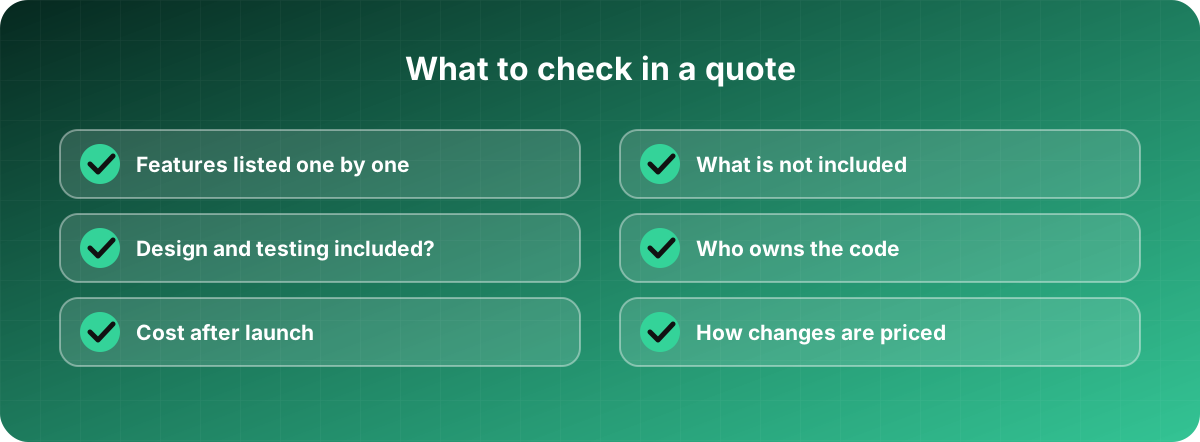
Give each company the same written brief. Ask them to list what's included and what isn't. Ask how they handle changes, since you'll want some. And ask who owns the code when it's finished, which should be you.
Then talk to them. How they ask questions tells you a lot. A team that probes your goals, challenges a feature or two and points out risks is usually more trustworthy than one that says yes to everything.
Ways to keep costs under control
Build less first. A smaller first version that real people use will teach you more than a big one nobody has seen. Split the work into phases, with a clear deliverable at the end of each, so you can stop or change direction. And decide what matters most. Everything can't be a priority.