Every few months a new framework is declared the future of the web. Instead of chasing trends, choose your technology stack by looking at your own situation. A good stack is one your team can build with quickly, run reliably and change safely for years.
What is a technology stack?
A stack is the set of technologies that make up your application: the programming language and framework on the server, the database, the front-end tools, the hosting and the supporting services such as caching, queues and monitoring. Choices at each layer affect cost, speed and how easy the product is to maintain.
Questions to ask first
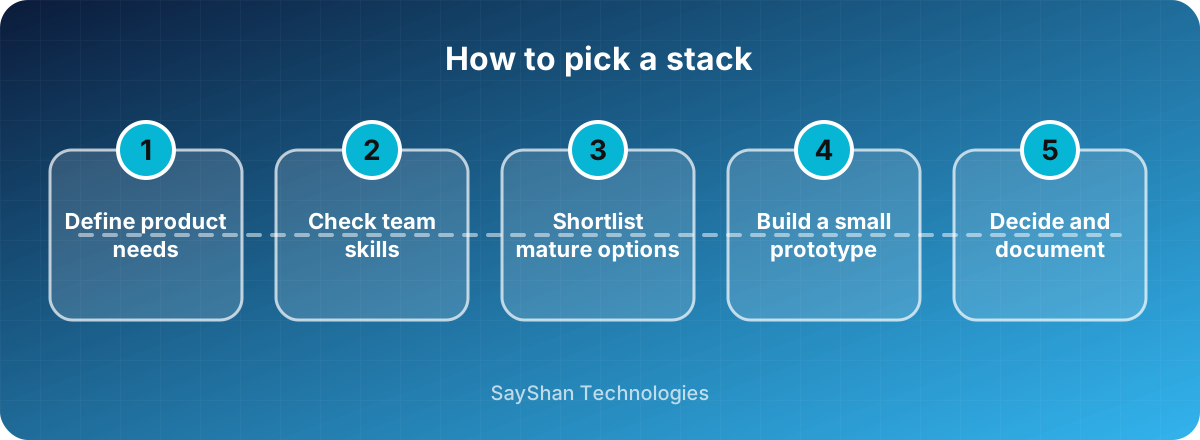
- What does the product need? A content-heavy marketing site, a real-time dashboard and an online store each have different needs. Write down the three most important requirements.
- Who will build and maintain it? A stack your team already knows is faster to build and safer to run than a fashionable one nobody has used in production.
- How long must it last? Mature frameworks with large communities make hiring, upgrades and security fixes easier.
- What must it integrate with? Payment gateways, ERPs, mobile apps and existing APIs can narrow the choice quickly.
- What are the constraints? Budget, timeline, compliance and where your users are located all matter.
A sensible default for business applications
For most business web applications, a mature server-side framework paired with a relational database is productive and reliable. Popular, well-supported choices include Laravel (PHP), Django (Python), Spring Boot (Java) and ASP.NET (C#). Add a JavaScript framework such as React or Vue only where the interface is highly interactive.
Why this combination works so well:
- Batteries included. Authentication, validation, database access and security protections are built in.
- Large talent pool. It is easy to find developers and documentation.
- Predictable costs. Hosting options are plentiful and well understood.
- Room to grow. You can add caching, queues and search as traffic increases.
When a different approach fits better
- Highly interactive apps such as design tools and dashboards benefit from a rich front-end framework talking to an API.
- Content and marketing sites often work best with a CMS or static site generator for speed and low cost.
- Real-time features such as chat and live tracking may need WebSockets or a managed real-time service.
- Heavy data and AI workloads pair well with Python services alongside your main application.
Build a small prototype
Before committing, build one real slice of the product: sign-in, one important screen and one integration. A prototype of a few days reveals friction that no comparison article will show, and it gives your team confidence.
Traps to avoid
- Rewriting everything in a new technology without a clear business reason.
- Choosing microservices before you have the team and traffic that need them. A well-organised monolith is easier to start with.
- Picking a tool because a large company uses it. Their problems are rarely yours.
- Leaving hosting, monitoring and backups until launch week.
Document the decision
Write a short note explaining what you chose, the alternatives you considered and why. Future team members will thank you, and you will know when the reasons no longer hold.
Key takeaways
- Start from product needs, team skills and constraints, not from trends.
- A mature framework plus a relational database fits most business apps.
- Prototype a thin slice before you commit.
- Keep the architecture simple and scale it when real usage demands.
Keep learning
Frequently asked questions
Should I use microservices from day one?
Rarely. Start with a modular monolith and split out services when specific parts need independent scaling or separate teams.
Is PHP still a good choice?
Yes. Modern PHP with a framework like Laravel is fast, well-supported and powers a large share of the web. Choose it if it fits your team and product.
How much does the choice of database matter?
Quite a lot for data-heavy products, but a relational database such as PostgreSQL or MySQL is a safe default for most business applications.
Can we change the stack later?
Yes, but it is expensive. Good architecture, tests and clear boundaries make future migrations far less painful.