Many startups spend months and large budgets building features nobody asked for, only to learn that the core idea needed a different shape. A good minimum viable product (MVP) does the opposite: it tests your biggest assumption as quickly and cheaply as possible, so you learn before you overspend.
What an MVP really is
An MVP is not a low-quality or half-finished product. It is the smallest version that delivers real value to a specific group of users and lets you learn whether the idea works. "Minimum" refers to the number of features; "viable" means it must actually solve the problem well enough to be used.
Step 1: define the one problem
Write a single sentence: "We help [who] do [what] without [pain]." If you need several sentences, the scope is probably too large. Then list your riskiest assumptions, for example "customers will pay for this", "they will switch from spreadsheets" or "we can acquire users affordably". Your MVP exists to test the biggest one.
Step 2: cut ruthlessly
List every feature you can imagine, then mark each as:
- Must have to test the idea.
- Nice to have.
- Later.
Ship only the first group. Admin panels, advanced reports, multiple user roles, elaborate settings and many integrations can almost always wait. Ask for each feature: "What would we learn if we did not build this?"
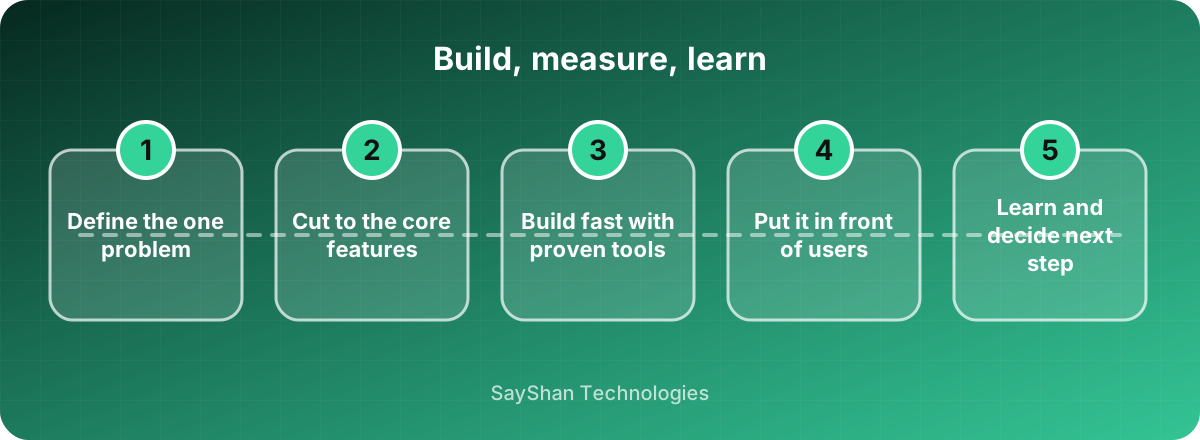
Step 3: choose speed-friendly technology
- Use a mature framework your team knows well.
- Use managed hosting rather than building infrastructure.
- Use existing services for payments, email, authentication, file storage and analytics.
- Consider no-code or low-code for internal tools and landing pages.
- Keep the code clean enough to grow, but do not over-engineer for millions of users you do not have yet.
Step 4: validate before you build everything
You can learn a lot without code:
- Interviews: talk to ten potential customers about their current problem and how they solve it.
- Landing page: describe the product and measure sign-ups or pre-orders.
- Clickable prototype: test the flow with real people before development.
- Concierge MVP: deliver the service manually behind the scenes, then automate what works.
Step 5: put it in front of real people early
Show a working version to potential customers within weeks. Watch how they use it, ask what they would pay for and listen to what they do, not only what they say. Even five honest sessions often reveal confusing steps and missing pieces.
Step 6: measure what matters
Decide the numbers before launch. Examples: percentage of visitors who sign up, users who complete the key action, week-two return rate, willingness to pay. Avoid vanity metrics such as page views that do not show real value.
Step 7: decide the next step
Agree in advance which results would make you:
- Persevere: build more of what works.
- Pivot: change direction based on what you learned.
- Stop: save your remaining budget for the next idea.
That discipline keeps the MVP honest and protects your money.
Common mistakes
- Building for a year before showing anyone.
- Adding features to please imaginary customers.
- Ignoring distribution; a great product that nobody finds still fails.
- Confusing a prototype with a product ready for scale.
Key takeaways
- An MVP is a learning tool that tests your riskiest assumption.
- Cut every feature that does not help you learn.
- Use proven tools and existing services to move fast.
- Show real users early and decide using pre-agreed numbers.
Keep learning
- How to Work Successfully with an Offshore Software Team
- Choosing the Right Stack for Your Web Application
Frequently asked questions
How much does an MVP cost?
It depends on scope, but a tightly scoped MVP is much cheaper than a full product. Cutting features is the biggest cost saver.
How long should it take to build?
Often a few weeks to a few months. If planning drags beyond that, reduce the scope.
Should an MVP be built by an agency or in-house?
Either can work. An experienced partner can speed up decisions and avoid common mistakes, while an in-house team gives deeper long-term ownership.
What happens after the MVP?
Use the feedback and data to prioritise the next features, improve quality and plan for growth, including better architecture and monitoring.